Lunch & Learn Series
Sharing pedagogical tools, insights, and approaches within our academic community, fostering collaboration and innovation in teaching and learning.
The Wood Centre Lunch & Learn Series brings together faculty and staff to explore new teaching tools, share innovative approaches, and spark collaborative conversations. Each session is designed to provide practical strategies that enhance learning and foster a community of innovation. Explore the summaries below for insights into each session and key takeaways.
AI & Assessment Design Workshop
cortney hanna-benson & dani dilkes
November 2025
Thank you to everyone who joined our extended three-hour Lunch and Learn session focused on one of the most pressing topics in contemporary teaching: how to adapt assessment design in an era of rapidly advancing generative AI. The session built on our August workshop and ongoing conversations this semester, offering space for collective reflection, practical exploration, and thoughtful dialogue about how AI is reshaping the way we teach and evaluate learning.
Facilitated by Dr. Cortney Hanna-Benson, Associate Director, Digital Learning, and Dani Dilkes, eLearning and Curriculum Specialist at Western University’s Centre for Teaching and Learning, the workshop guided participants through a series of discussions and activities exploring:
How our pedagogical values should guide AI use
- An analysis of prototypical assessments at Ivey.
- Approaches to designing assessments in a post-AI classroom
The session encouraged instructors to critically reflect on where AI challenges existing assessment models, where it offers new possibilities, and how we might collectively evolve our practices to maintain academic integrity while supporting deeper student learning.
Exploring Practices in Rubric Design and Implementation
Tiffany Bayley, ken meadows & Mandy penney
October 2025
In collaboration with the Building Up Our Teaching Community series this session hosted by Tiffany Bayley, with Ken Meadows and Mandy Penney from Western University Centre for Teaching and Learning, explored how well-designed rubrics can promote fairness, support inclusivity, and serve as powerful teaching and communication tools. Participants analyzed different types of rubrics, explored a variety of rubric purposes, and engaged in collaborative exercises to apply rubric design to their own assessments.
Faculty were encouraged to bring either an existing assessment with a rubric or an assessment that could benefit from rubric incorporation. The workshop emphasized practical strategies for designing rubrics that are adaptable, clear, and aligned with course learning outcomes while fostering creativity and engaged learning.
Key Takeaways
- 5 Principles of Rubric Design:
- Align with learning outcomes.
- Use clear, descriptive, and specific language.
- Share with students in advance.
- Align with and be adaptable for disciplinary, student, and instructor contexts.
- Balance specificity and flexibility / creativity
- Choose the rubric type that best fits your course's learning objectives and assessment style: Analytic, Holistic, or Single Point.
- Rubric ≠ Grading Key
Participants explored practical strategies for designing clear, adaptable, and purposeful rubrics that enhance learning, support fairness, and foster student engagement.
Creating Deeper Connections in the Classroom
Mazi Raz & the artist collective wild soma
September 2025
This interactive session explored meaningful engagement in the classroom, focusing on how faculty and students can cultivate deeper, reciprocal connections. Prof. Mazi Raz and the artist collective Wild Soma guided participants through sensory-rich, embodied practices designed to expand attention, reflection, and relational awareness in learning spaces.
The session challenged conventional modes of teaching by emphasizing non-linear approaches, physical engagement, and interaction with non-human objects to spark reflection and shift habitual learning patterns. Faculty were invited to explore unfamiliar ways of knowing that complement cognitive approaches, encouraging curiosity, presence, and connection.
Wild Soma’s approach is informed by Indigenous, accessibility, and pedagogical advisors, and the session was supported through a multi-year Strategic Innovation Grant from the Canada Council for the Arts.
Key Takeaways
- Embodied awareness can deepen engagement by attuning to presence, mood, and relational dynamics in the classroom.
- Altering physical space and introducing non-human connections, such as caring for a plant, can spark reflection and shift habitual patterns.
- Practices like shared breath and back-to-back contact invite participants to quiet the analytical mind and experience learning through the body.
- Non-linear, sensory-rich approaches challenge academic norms that privilege cognitive engagement and structured takeaways.
- Faculty responses ranged from feeling belonging and connection to discomfort and resistance, highlighting both the challenge and promise of embodied practices.
Participants explored how embodied, sensory-rich practices can foster deeper engagement, relational awareness, and transformative learning in the classroom.
Reflections
As part of our ongoing efforts to strengthen the teaching community, Mazi Raz and Wild Soma led a 90-minute session with four movement artists and a dance choreographer, designed around two core intentions:
1. Embodied Awareness for Deeper Engagement
Participants experienced a non-linear, sensory-rich session that disrupted conventional learning modes. The physical space was transformed, and participants engaged with non-human objects, including caring for a plant as a living companion. Activities such as sitting in unfamiliar arrangements, breathing together, and connecting physically (e.g., back-to-back exercises) encouraged participants to quiet the analytical mind and inhabit their fuller human capacities. The exercises sparked reflection, humor, and insight, highlighting the power of embodied engagement in educational spaces.
2. Exploring Unfamiliar Learning Modes
The session intentionally contrasted with typical academic approaches, privileging cognitive engagement and structured reasoning. By emphasizing somatic intelligence, the session challenged participants to step outside habitual patterns and embrace discomfort, uncertainty, and new forms of insight.
Faculty responses were diverse, ranging from feelings of belonging and connection to initial resistance or discomfort. This diversity underscores the potential of embodied practices to foster meaningful engagement, deepen understanding, and expand perceptions of teaching and learning.
Coffee, Chai and Gen AI
darren meister & cortney hanna-benson
August 2025
The session continued the Coffee, Chai and Gen AI conversation, focusing on the responsible use of generative AI in teaching and learning. Professor Darren Meister, and Dr. Cortney Hanna-Benson, Associate Director, Digital Learning at Western University Centre for Teaching and Learning, facilitated an interactive discussion on metacognitive development for AI, exploring how assessment design can evolve in an AI-enabled classroom. Faculty reflected on opportunities to rethink assessment, balancing fairness, authenticity, and integrity while fostering critical thinking, curiousity, collaboration and creativity.
Key Takeaways
- Design tasks that require personal reflection and application beyond AI-generated outputs; acknowledge biases and limitations in cases and materials.
- Balance standardization with flexibility, including the use of structured or subjective rubrics for innovative work.
- Ensure major assessments maintain fairness while allowing creativity and metacognitive engagement.
- Build a culture of ethical AI use rather than relying solely on surveillance; explore practical strategies to support honesty.
- Involve students in co-designing assessments and learning tasks, encouraging peer learning and discovery-based approaches.
- Emphasize open-ended, reflective, and metacognitive assignments.
Faculty explored how AI can serve as a tool to enhance reflection, exploration, and creativity without replacing human judgment or lived experience. The discussion also highlighted guiding principles for future Assessment Design & AI workshops.
Coffee, Tea and ChatGPT* 2
rob austin & isam faik
April 2025
The second session in our Coffee, Tea and ChatGPT* series focused on the responsible use of generative AI in the classroom. Professors Rob Austin, Evolution of Work Chair & Isam Faik led an interactive discussion and shared best practices, using mini case studies to explore how generative AI can shape both teaching and learning. The session aimed to support faculty is setting classroom norms and expectations for students engaging with AI tools.
Key Takeaways
- Generative AI summarizes content quickly, but may reduce social engagement and critical thinking if not guided.
- Encourage reflection on assumptions and reasoning behind AI-generated answers.
- Generative AI can act as a “classroom assistant” for preparation, discussion, or team projects.
- Communicate the purpose of AI use and provide structured prompts for responsible engagement.
- Using AI thoughtfully prepares students for professional environments and ethical decision-making.
Faculty discussed how AI tools can enrich the learning process when integrated thoughtfully, balancing efficiency with deep understanding.
Demo Day: An Excel Tool for Contribution Tracking and Insights
Kyle Maclean
March 2025
In collaboration with the Building Up Our Teaching Community seminar series, Prof. Kyle Maclean showcased an innovative tool designed specifically for the Ivey classroom. The tool helps instructors track student contribution efficiently and provides actionable insights into the classroom dynamics. Key features include seating map integration, a participation dashboard and a bias checker.
Key Takeaways
- Seating plan integration for fast, accurate input.
- Real-time participation dashboards to visualize engagement.
- Built in bias checker to support fair and equitable evaluation.
These tools are modular, allowing instructors to select the features they find most useful, while supporting efficient contribution tracking, and providing insights into classroom contribution dynamics.
Coffee, Tea & ChatGPT*
mark daley
January 2025
This session focused on generative AI in teaching and provided a space for learning, sharing, and discussing how we are currently using — or hope to use — generative AI in our teaching practices.
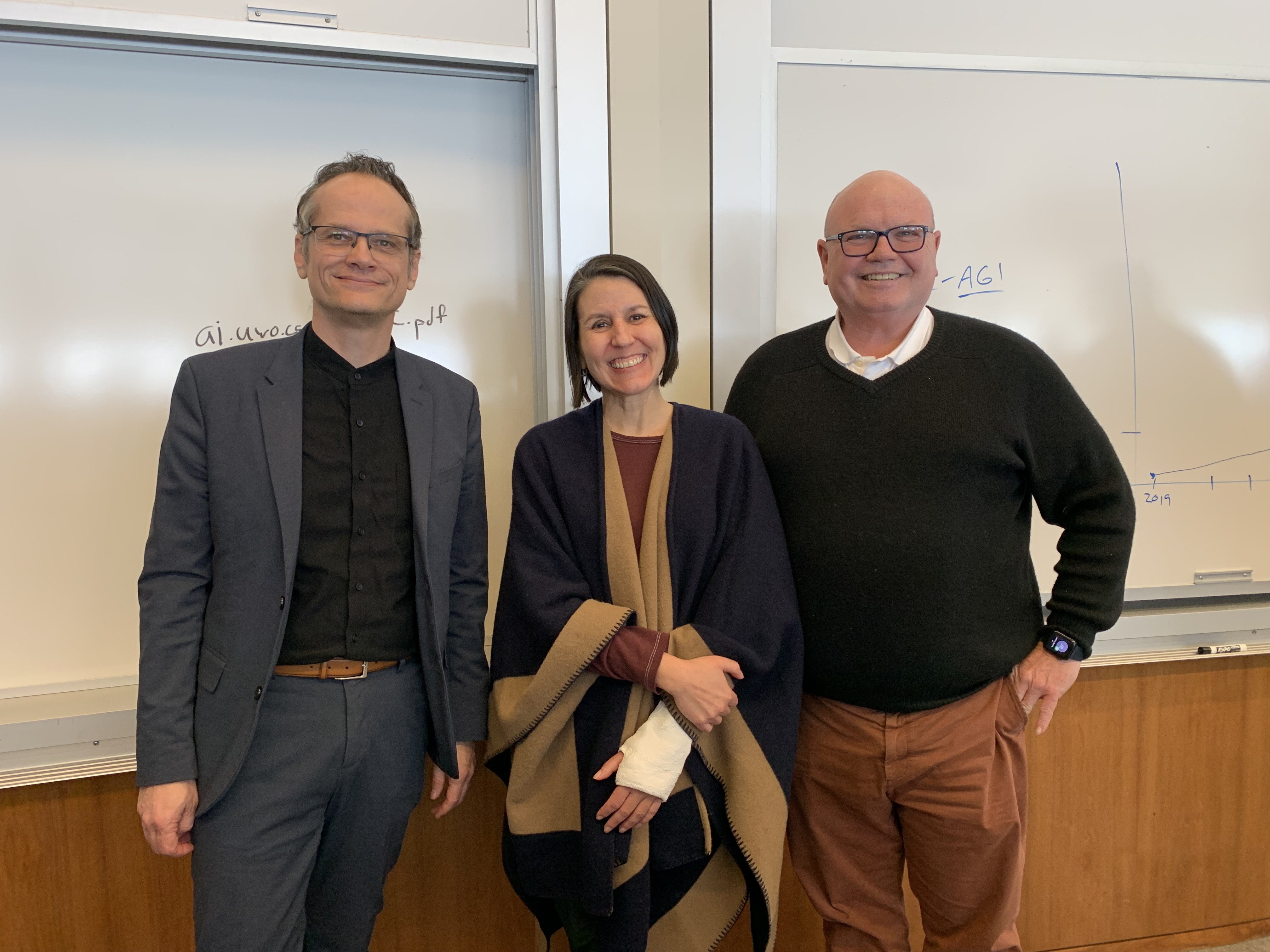
Profs. Mark Daley & Darren Meister introduced, supported and led the conversation on generative AI in teaching. Among the key takeaways from this dynamic interaction with a classroom of Ivey faculty, is the importance of an educators' role in this new era.
To create opportunities for learners to practice engaging productively and responsibly with each other and with their generative AI.
* We are grateful to Daniel A. Gruber and the W.P. Carey School of Business at Arizona State University for permission to use this name.